
Combustion Properties
Methane Number
The methane number (MN) is a dimensionless rating that measures how resistant a gaseous fuel is to engine knock, which happens when fuel ignites too early inside an engine cylinder. It serves the exact same purpose for gas engines that the octane rating serves for liquid gasoline engines.
How the Rating Scale Works
The methane number scale is anchored by two reference gases with opposite combustion behaviors:
- Pure Methane (MN = 100): Methane burns slowly and requires a lot of heat and pressure to auto-ignite, making it highly resistant to knock.
- Pure Hydrogen (MN = 0): Hydrogen burns very fast and ignites easily under pressure, giving it almost zero resistance to knock.
- Measuring a Fuel: A gas with a methane number of 85 behaves the same way inside an engine as a laboratory blend of 85% methane and 15% hydrogen by volume.
What Happens During “Engine Knock”
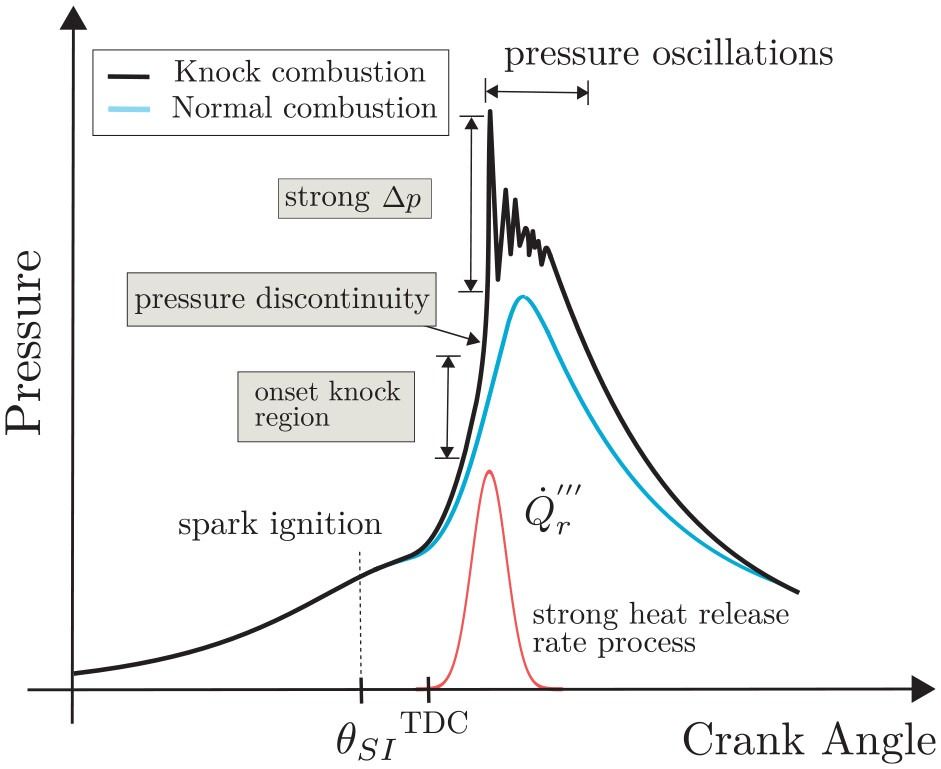
In a spark-ignited gas engine, the spark plug ignites the air-fuel mixture at a precise moment. This creates a smooth, controlled flame front that pushes the piston down.
If the fuel’s methane number is too low for the engine’s compression ratio, the heat and pressure inside the cylinder cause pockets of gas to self-ignite before the spark plug’s flame reaches them. These colliding pressure waves create a metallic pinging or knocking sound, generate extreme localized heat, and can rapidly destroy pistons, valves, and cylinder heads.
How Gas Composition Changes the Methane Number
Because natural gas and biogas are mixtures of several gases rather than pure methane, their methane numbers vary widely depending on what else is in the mix:
| Gas Component | Effect on Methane Number | Why It Happens |
| Heavier Hydrocarbons (Ethane, Propane, Butane) | Lowers MN | Longer carbon chains break apart more easily under heat, causing faster auto-ignition. Even small amounts of butane or pentane drop the MN sharply. |
| Hydrogen (H₂) | Lowers MN | Hydrogen has very low ignition energy and high flame speed, making the blend much more prone to knocking. |
| Inert Gases (CO₂, Nitrogen) | Raises MN | These gases do not burn. Instead, they absorb heat inside the cylinder, cooling the combustion process and preventing premature ignition. |
Typical Methane Numbers by Fuel Type
- Biogas and Landfill Gas (MN 110 to 140+): Because these gases contain high levels of carbon dioxide (CO₂), their knock resistance actually exceeds that of pure methane.
- Pipeline Natural Gas (MN 70 to 95): Most commercial natural gas falls in this range, depending on how much ethane and propane remain after processing.
- Associated Petroleum Gas / Flare Gas (MN 30 to 65): Raw gas from oil wells often contains heavy hydrocarbons like propane and butane, requiring engines to lower their power output or adjust ignition timing to avoid damage.
Calculation Standards
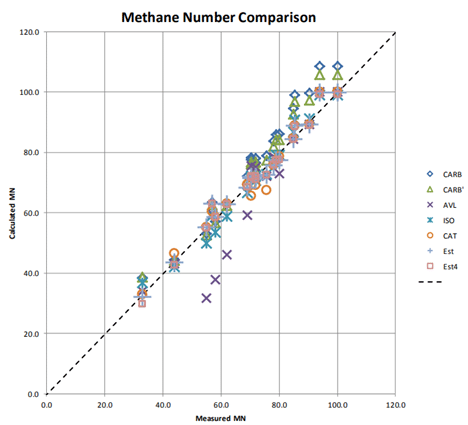
Unlike octane ratings, which are tested in a standardized physical engine, Methane Numbers are almost always calculated mathematically from the individual mol% per component. Because different engine manufacturers weigh the impact of heavy hydrocarbons slightly differently, several calculation standards exist—such as the AVL, MWM, Caterpillar, Wartsila, and EU (EN 16726) methods—meaning the exact same gas sample might (slightly) different numbers depending on the formula used.