
Combustion Properties
Stoichiometric Air Fuel Ratio (AFR)
The stoichiometric air-fuel ratio (AFR) is the exact mass or volume ratio of air to fuel required for complete combustion, leaving no unburned fuel and no excess oxygen.
In an ideal stoichiometric reaction, every fuel molecule reacts completely with oxygen to form only carbon dioxide (CO₂) and water vapor (H₂O).
Common Combustible Gas Stoichiometric Air-Fuel Ratios
Because gaseous fuels have different chemical structures and densities, each requires a different amount of air. Expressed either by mass (standard for liquid fuels and engine management) or by volume (common for gaseous fuels).
| Fuel Type | Typical Composition (by Volume) | By Mass (kg air / kg fuel) | By Volume (m3) air / m3 gas |
| Methane (CH4) | 100% CH4 | 17.2 : 1 | 9.52 : 1 |
| Biomethane | ~96–98% (CH4), 2–4% (CO2) | ~15.8 – 16.5 : 1 | ~9.1 – 9.3 : 1 |
| Natural Gas (H-Gas) | ~88–95% (CH4) + heavier HC | ~16.5 – 17.2 : 1 | ~9.5 – 10.5 : 1 |
| Groningen Gas (L-Gas) | ~81.3% (CH4), 14.3% (N2), 2.9% (C2H6) | ~13.1 : 1 | ~8.4 : 1 |
| Biogas (Raw) | ~60% (CH4), 40% (CO2) | ~6.1 : 1 | ~5.7 : 1 |
| Propane (C3H8) | 100% (C3H8) | 15.7 : 1 | 23.8 : 1 |
| Propane95-Air (SNG) | ~55% Propane-95, ~45% Air | ~9.9 : 1 | ~12.7 : 1 |
| Hydrogen (H2) | 100% (H2) | 34.3 : 1 | 2.38 : 1 |
How it Works for Methane (CH4)
- Chemical Balance: One molecule of methane requires two molecules of oxygen (O₂) to burn completely: CH₄ + 2O₂ → CO₂ + 2H₂O.
- Accounting for Nitrogen: Dry air is roughly 21% oxygen and 79% nitrogen by volume. To get 2 parts oxygen, you need 2 / 0.21 = 9.52 parts air by volume.
- Converting to Mass: Using the molecular weights of methane (16 g/mol) and dry air (~28.97 g/mol), the mass ratio comes out to 17.2 kg of air per 1 kg of methane.
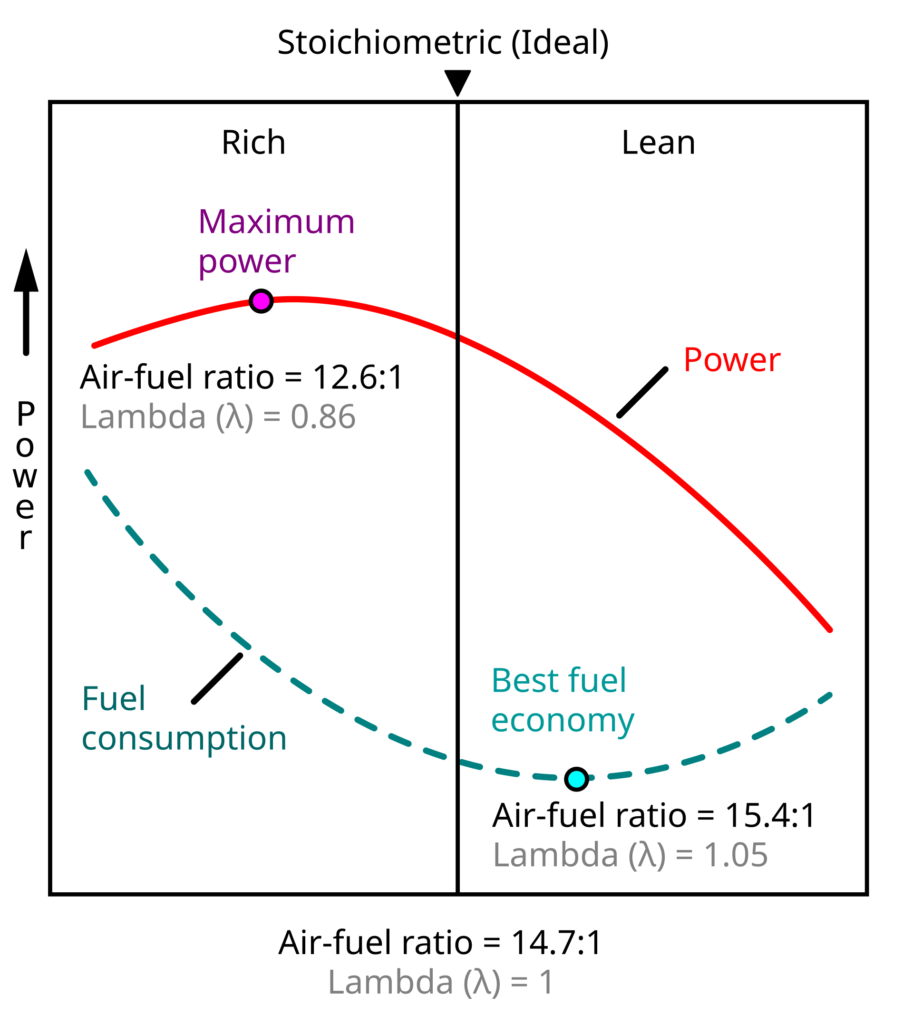
Rich vs. Lean Mixtures (Lambda, λ)
In real engines and burners, operators rarely run at the exact stoichiometric point. They adjust the mixture using Lambda (λ), which divides the actual AFR by the stoichiometric AFR:
- Stoichiometric (λ = 1.0): Exact chemical balance. Used in standard three-way catalytic converter gasoline engines to minimize emissions.
- Rich Mixture (λ < 1.0): More fuel than air. Produces higher peak power and cooler exhaust temperatures, but leaves unburned fuel (carbon monoxide and hydrocarbons).
- Lean Mixture (λ > 1.0): More air than fuel. Industrial gas engines (like CHP generators) typically run very lean (λ = 1.5 to 2.0) to lower combustion temperatures, prevent engine knock, and reduce nitrogen oxide (NOx) emissions.