
Combustion Properties
Biomethane-RNG
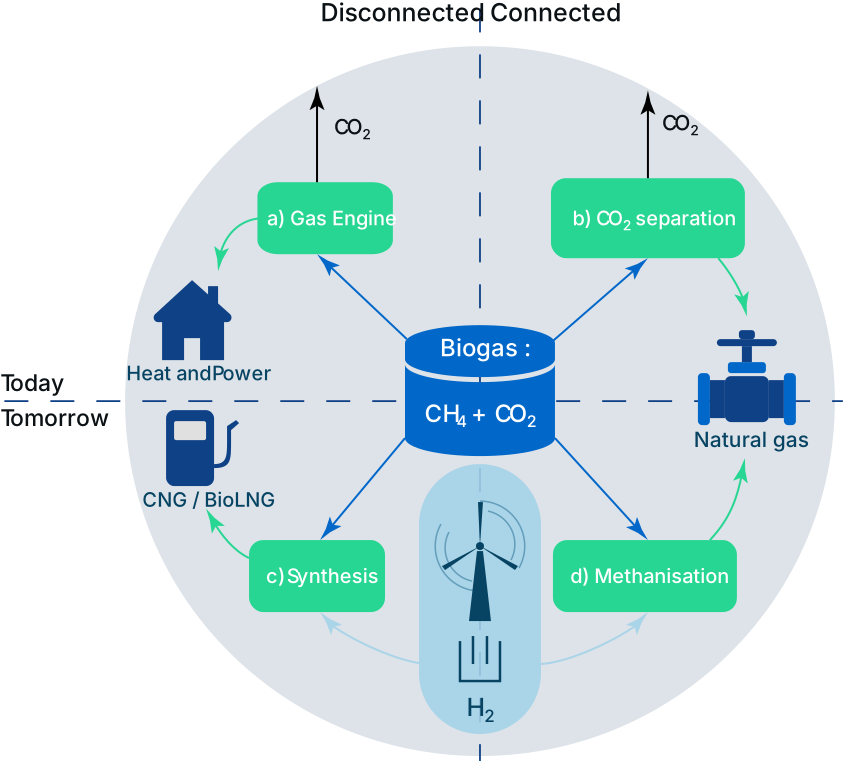
Biomethane, also called Renewable Natural Gas (RNG), is purified biogas upgraded to match the quality of H-gas (high-calorific natural gas), requiring a methane (CH4) content typically above 96% by volume so it can safely enter natural gas pipelines or power vehicles.
Unlike raw biogas – which contains roughly 50-65% methane (CH4) and 35–45% carbon dioxide (CO2) along with corrosive impurities – biomethane undergoes strict upgrading to meet international standards like EN 16723 in Europe.
Core Quality & Composition Parameters
| Parameter | Typical Requirement (Grid / H-Gas) | Why It Matters |
|---|---|---|
| Methane (CH4) | ≥ 96% vol. | Ensures high energy density and combustion performance identical to natural gas. |
| Carbon Dioxide (CO2) | ≤ 2% – 5% vol. | Excess CO2 dilutes heating value and forms carbonic acid if moisture is present. |
| Hydrogen Sulfide (H2S) | ≤ 4 – 5 mg/m3 (or ~4 ppm) | Extremely toxic and corrosive to pipelines, compressors, and engine parts. |
| Total Sulfur | ≤ 30 mg/m3 (≤ 10 mg/m3 for vehicles) | Prevents catalyst poisoning in vehicles and reduces SO2 emissions. |
| Oxygen (O2) | ≤ 0.01% – 3% vol. (grid-dependent) | Tight limits prevent internal pipeline corrosion and explosive mixtures. |
| Water Dew Point | ≤ -8°C to -20°C (pressure-dependent) | Prevents water condensation, ice formation, and acid corrosion in pipes. |
| Siloxanes (as Si) | ≤ 0.3 – 1.0 mg/m3 | Common in wastewater/landfill gas; burns into abrasive silica deposits that ruin turbines and engines. |
| Ammonia (NH3) & Amines | ≤ 10 mg/m3 | Protects copper/brass fittings and downstream equipment from corrosion. |
Key Combustion & Interchangeability Metrics
- Wobbe Index: Measures gas interchangeability to ensure burners produce the same heat output without flame lift or soot. For H-gas networks, this typically sits between 13.4 and 16.1 kWh/m3.
- Methane Number (MN): Used primarily for automotive fuel (EN 16723-2), requiring a minimum of 65 to prevent engine knocking.
- Odorization: Like natural gas and LPG, odorless biomethane must be odorized (commonly with tetrahydrothiophene (THT) at ≥ 10 mg/Nm3 in Switzerland) before distribution so leaks are easily detected.
Two Main Regulatory Categories
- Grid Injection (EN 16723-1): Focuses on pipeline integrity, Wobbe index matching, and strict limits on oxygen, moisture, and trace contaminants.
- Automotive Fuel (EN 16723-2): Applies stricter limits on siloxanes (≤ 0.3 mg Si/m3), total sulfur (≤ 10 mg/m3), and water dew point (to prevent freezing during high-pressure CNG refueling at 200+ bar).
To inject biomethane into the gas grid or use it as vehicle fuel, raw biogas undergoes a multi-stage purification process to meet strict chemical, physical, and combustion standards (such as European EN 16723).
1. Physical & Combustion Properties (Interchangeability)
Gas appliances, turbines, and vehicle engines are calibrated for fossil natural gas. Biomethane must replicate its burning behavior so equipment runs safely without adjustments.
- Gross Calorific Value (Hs): Measures the total heat released during complete combustion (typically 10.7 to 12.8 kWh/m3 for H-gas grids). Because pure methane has a slightly lower calorific value than natural gas containing ethane/propane, grid operators occasionally add small amounts of LPG (propane) to boost the heating value if needed.
- Wobbe Index (Ws): The most critical interchangeability metric, defined as the calorific value divided by the square root of the gas’s relative density (Ws = Hs√d). Two gases with the same Wobbe Index deliver the exact same thermal energy through a burner nozzle at a given pressure.
– Too low: Causes flame lift or incomplete combustion.
– Too high: Causes overheating, soot formation, and carbon monoxide (CO) spikes. - Relative Density (d): The ratio of the gas’s density to dry air (typically 0.55 to 0.70). Pure methane (0.554) is much lighter than air, meaning leaks rise and disperse quickly, unlike LPG (propane/butane), which is heavier than air and pools near the floor.
- Methane Number (MN): Comparable to the octane rating in gasoline, it measures knock resistance in internal combustion engines. Pure methane has an MN of 100; standard EN 16723-2 requires MN ≥ 65 (though some vehicle manufacturers require ≥ 70–80). Hydrogen or higher hydrocarbons lower this number.
2. Trace Impurities & Why They Are Regulated
Even parts-per-million (ppm) levels of raw biogas contaminants can destroy pipelines, compressors, and catalytic converters.
- Siloxanes (Organic Silicon Compounds): Found heavily in biogas from wastewater treatment plants (WWTPs) and landfills (originating from shampoos, cosmetics, and detergents). During combustion, siloxanes oxidize into microcrystalline silicon dioxide (SiO2) – essentially sand/glass – which coats spark plugs, pistons, turbochargers, and catalysts, causing rapid mechanical failure.
- Hydrogen Sulfide (H2S) & Total Sulfur: H2S reacts with water and forms sulfuric acid, causing severe pitting corrosion in steel pipelines and copper fittings. In vehicles, sulfur permanently poisons exhaust catalysts.
- Oxygen (O2) & Nitrogen (N2): Usually enter raw biogas if air is injected into the digester for biological desulfurization, or via leaks in vacuum landfill collection pipes.
– Oxygen accelerates pipeline corrosion and risks forming an explosive mixture if concentrated.
– Nitrogen cannot be easily removed by standard upgrading membranes/scrubbers; it acts as an inert ballast that lowers the Wobbe Index and calorific value. - Water Vapor (Dew Point): Must be dried so water never condenses at the pipeline’s maximum operating pressure. Liquid water combines with CO2 and trace H2S to create acids, and in CNG vehicles (compressed to 200–250 bar), moisture causes ice plugs in valves during rapid expansion.
- Halogenated Hydrocarbons (Chlorine/Fluorine compounds): Common in landfill gas from refrigerants, solvents, and plastics; they form hydrochloric (HCl) or hydrofluoric (HF) acids during combustion, corroding engine cylinders.
- Ammonia (NH3) & Amines: Produced during the digestion of protein-rich feedstocks (like manure or food waste). Ammonia causes stress-corrosion cracking in copper and brass components.
3. Feedstock Impact on Gas Quality
The source of the raw biogas dictates which purification steps are hardest:
| Feedstock Source | Typical Raw CH4 | Primary Quality Challenges |
|---|---|---|
| Agricultural (Manure / Energy Crops) | 52% – 60% | High ammonia (NH3) and hydrogen sulfide (H2S); virtually zero siloxanes. |
| Wastewater Treatment (Sewage Sludge) | 60% – 65% | High siloxanes and moderate H2S. |
| Landfill Gas | 45% – 55% | High nitrogen (N2), oxygen (O2), siloxanes, and halogens; often requires specialized cryogenic or PSA nitrogen removal. |
| Organic Municipal / Food Waste | 55% – 65% | Fluctuating H2S, terpenes (VOCs from citrus/cleaning agents that mask odorants), and ammonia. |
4. How Upgrading Technologies Achieve Grid Quality
Raw biogas is first pre-cleaned (using activated carbon filters for siloxanes/VOCs, iron oxide/biological scrubbers for H2S, and condensate traps/dryers for water) before bulk CO2 separation:
- Membrane Separation (Most Common in Europe): Uses hollow-fiber polymer membranes that allow small molecules (CO2, H2O, H2S) to permeate through quickly while retaining larger methane (CH4) molecules under pressure. Produces 96%–99% CH4.
- Amine Scrubbing (Chemical Absorption): Uses a liquid amine solution that chemically binds to CO2, achieving the highest methane purity (> 99% CH4) with virtually zero methane slip (< 0.1%), though it requires heat to regenerate the amine solution.
- Water Scrubbing (Physical Absorption): Pressurized water dissolves CO2 and H2S (which are far more soluble in water than methane), yielding 96%–98% CH4.
- Pressure Swing Adsorption (PSA): Uses porous molecular sieves (activated carbon or zeolites) that trap CO2, N2, and O2 under high pressure and release them when depressurized.
5. Quality Monitoring & Odorization at the Feed-In Point
Before entering a public network, a continuous gas quality and dew-point analyzer verify gas quality in real time. If any parameter – such as oxygen, water dew point, or Wobbe Index – drifts out of bounds, an automated shut-off valve immediately diverts the gas to a flare or buffer tank. Finally, tetrahydrothiophene (THT) or mercaptan odorant is dosed into the gas stream right before grid entry.